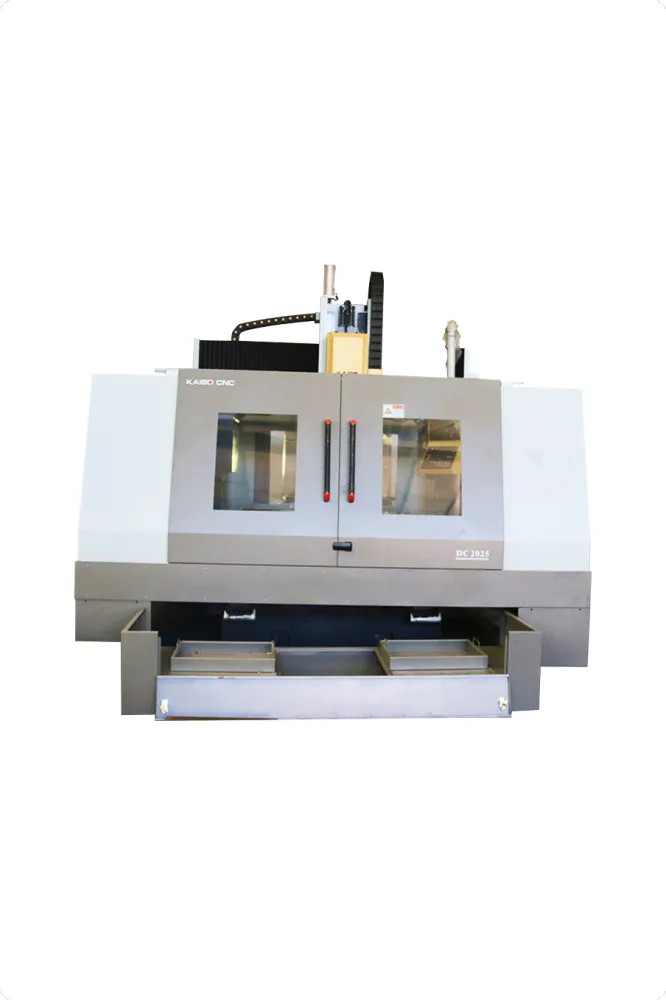
In the precision-driven world of mold and die manufacturing, material selection often dictates machine capability more than design complexity. Stainless steel, titanium alloys, and hardened steels—common in aerospace, automotive, and medical tooling—are notoriously difficult to machine due to their high hardness, low thermal conductivity, and tendency to work-harden.
When processing these materials, even minor deviations in spindle vibration or table positioning can lead to tool wear, dimensional inaccuracies, or surface defects that compromise part integrity. That’s why companies like Kaibo CNC have built machines around three pillars: rigorous quality management, comprehensive testing protocols, and global technical support.
Take the GJ1417 High-Precision龙门式 CNC Milling Machine, for example—a model widely adopted by OEMs producing molds for injection molding and die casting. This machine is not just another CNC platform—it's engineered for consistency under pressure.
What sets the GJ1417 apart isn’t just its powerful servo motors or high-rigidity frame—it’s the systematic approach to reliability. Every unit undergoes over 70 individual tests before leaving the factory, including:
These aren't arbitrary checks—they're aligned with ISO9001 standards, which ensure process control, traceability, and continuous improvement. For manufacturers operating at scale, this means fewer rejects, less rework, and predictable throughput.
A mid-sized mold shop in Malaysia faced recurring issues when machining stainless steel inserts for plastic molds. Their old CNC mill delivered inconsistent surface finishes and frequent tool breakage after just 3–4 hours of operation. After switching to the GJ1417, they reported:
This case underscores a key insight: choosing a machine isn’t about horsepower alone—it’s about how well it maintains performance over time under real-world conditions.
Even the best machine needs timely intervention when problems arise. With 26 service centers worldwide—from Germany to UAE to Mexico—the GJ1417 offers rapid on-site diagnostics, spare parts availability, and remote troubleshooting via IoT-enabled monitoring systems.
One client in Dubai noted that during a critical production run, a controller error was resolved remotely within 45 minutes thanks to live data sharing between their engineers and Kaibo’s tech team. Without such support, the downtime could have cost up to $12,000 in lost orders.
For B2B buyers evaluating CNC equipment, this level of post-sale commitment transforms a capital purchase into a strategic asset—not just a piece of metal.